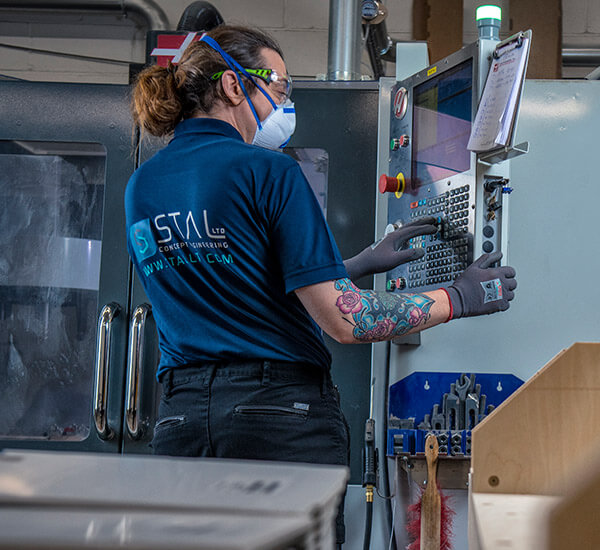
Our investment in the very latest CAD/CAM processing systems means our highly skilled Engineering Team and CNC operators are able to generate complex tool paths from 3D models and drawings. It’s a process that works equally as well for reverse engineering where technical drawings for existing parts do not exist, and we need to develop 3D models.
Our CNC machining capabilities offer you superior flexibility
We have 3 axis and 5 axis machines with a machining capacity of 3.0m (X) x 1.5m (Y) x 1.5m (Z). This flexibility in size means we can accommodate most sizes of components.
Our 5-axis Biesse Materia CL self-contained machining centre is versatile and compact. It is designed to meet a wide variety of high-speed machining needs, particularly for components with larger Z axis requirements. It makes light work of machining composites, acrylics, foams, plastics and advanced materials including carbon fibre and alloy coated materials.
We apply the same due diligence to the purchase of our capital equipment as we do to our manufacturing and design. We chose Biesse after meeting their manufacturing team in Italy, and in the knowledge that our investment would not only allow us to take on bigger projects, but also significantly reduce turnaround time.
We are proud to be the first company in the UK to purchase a Biesse Materia CL. It was a decision driven by our need for a more versatile and larger CNC machine. Having the machine capability to process aluminium as well as composite materials has allowed us to fulfil our growth ambitions in the aerospace, automotive and motorsports sectors.
We’re experts in choosing the best composite material solution
Composite materials like carbon fibre can be found in every aspect of our lives. Their combined lightness and strength make them the perfect choice for air and marine transport, automotive, wind energy and leisure. They help to reduce weight and fuel consumption, and are flexible enough to be moulded into complex shapes more effectively than steel, aluminium or titanium.
Bringing together two substances with entirely different physical properties does, however, present a challenge when it comes to machining. Their abrasive content can compromise quality, and cause vibrations and splintering. It requires an expert approach.
AT STAL, we are highly skilled in choosing the right combination of materials, and the machining strategy to match.
Some of our CNC machining projects…
Carbon fibre headlight enclosure for a world-leading sports car manufacturer
We were approached by our customer to a produce a prototype vacuum tooling fixture and machining strategy, for first off part machining prior to being productionised at their main factory. This project helped establish cycle times and de-risked the entire machining process. The project was completed in less than three weeks following the initial project conversation.
Water feature for Jo Whiley BBC Radio 2’s RHS Chelsea Flower Show Scent Garden
In this project we were asked to manufacture tooling for a cast concrete water feature. We had a very short lead time to design (from the supplied sketch) and manufacture the mould. The tooling was only required to make a one-off so the mould was machined direct from MDF.
Camera case for the aviation industry
We were asked by our client to provide machining fixture design, manufacture and machining services, to machine these delicate carbon fibre components. The vacuum fixture was designed to incorporate sub 1.0mm channels with automatic zonal off/on vacuum ports so that the part was always fully vacuumed to the fixture even when ports were no longer in contact with the part. This attention to the tooling design at the outset of the project enabled a very predictable process and ensured the parts were machined well within the desired dimensional tolerance.
Plastic pallet aluminium mould tool
We designed and machined the pallet tool direct from two solid pieces of aluminium billet, each measuring 1300mm x 1150mm x 180mm. The parts fitted side by side on our large 5 axis CNC machine which allowed for a more efficient machining process, because the machine could be left to run unattended.